
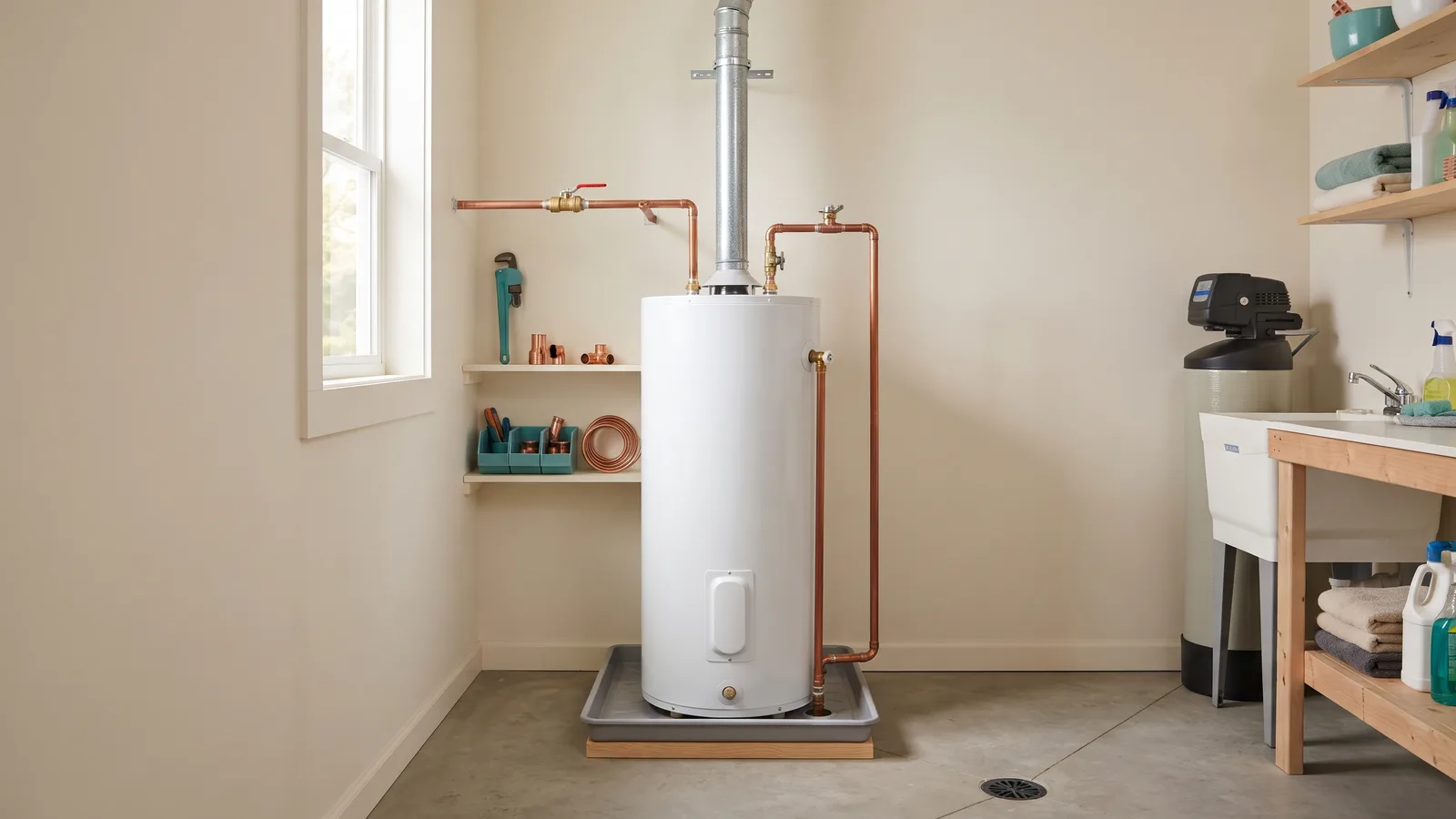
Water heater installation cost ranges by job type
For 2026 planning, treat $600-$3,100 as the broad installed range for a standard tank replacement and $1,400-$5,600 as the broad installed range for tankless installation, based on HomeGuide. A heat pump water heater sits in a different band again, with Angi listing $3,200-$4,700 for professional installation.
| Metric | Value | Source |
|---|---|---|
| Standard tank replacement | $600-$3,100 installed | HomeGuide, 2026 |
| Tankless installation | $1,400-$5,600 installed | HomeGuide, 2026 |
| Heat pump water heater installation | $3,200-$4,700 installed | Angi, 2026 |
These are planning bands, not quotes. A like-for-like tank job can stay closer to the lower end when the location, venting and connections are already suitable. A conversion job can climb because the installer may need to change venting, gas capacity, electrical service, condensate handling or clearance. If the choice is fuel source rather than just brand, start with our gas vs electric water heater installation cost guide.
The useful way to read the ranges is to ask what stays the same. If the replacement keeps the same storage-tank format, fuel type, location and basic connections, the quote should read like a replacement scope. If the quote changes heater type, mounting position, fuel delivery, venting or electrical supply, the quote should read like a conversion scope. That difference is why two homeowners can both be replacing a failed water heater and still receive very different numbers.
The ranges also explain why a product-only comparison can mislead. A lower unit price does not make a cheaper project if the chosen heater needs new venting, a different breaker setup, a larger gas supply, condensate handling, disposal or inspection coordination. The installed price is the decision number. The product price is only one input.
For quote comparison, ask each installer to write the heater type, capacity, fuel source, permit assumption, removal, disposal, basic materials and any excluded upgrades. A quote that simply says "replace water heater" is hard to compare because it hides the boundary between included work and later change orders.
Relative installed-cost bands
Quote scope matters more than the water heater price
The quote only makes sense when it separates the unit, labor and scope adders. The same homeowner can see a routine replacement quote and a much higher tankless or heat pump quote because the second job changes the building, not just the appliance.
Timing changes the scope too. A planned replacement can wait for permit checks and product availability. An urgent leak or no-hot-water failure often has fewer product choices and more safety triage, which is why our emergency water heater replacement guide separates safety, same-day limits and cost expectations. If the installer says the job will take longer than expected, compare the details against how long water heater installation takes.
A good scope conversation starts with the existing setup. Tell the plumber whether the current unit is gas, electric, tankless or heat pump, where it sits, whether it vents through a wall or roof, whether there is a drain pan, whether shutoff valves are accessible, and whether the failure is a leak, no hot water, unreliable hot water, noise or visible corrosion. Those details help separate repair, replacement and conversion paths.
The quote should also show what is not included. Permit fees, inspection scheduling, carpentry, platform repair, drywall, electrical panel upgrades, gas meter changes and code corrections can sit outside a basic replacement line. If the quote excludes them, that is not automatically wrong, but the exclusion needs to be visible before work begins.
When two quotes differ sharply, compare the assumptions before comparing the totals. One installer may be pricing a basic tank replacement. Another may be pricing a tankless conversion or a heat pump fit with electrical and condensate work. The higher quote might be padded, or it might simply include work the lower quote left out. The scope list is what tells you which is true.
Quote red flags to slow down for
Slow down when a quote does not name the heater type, excludes permit responsibility without explaining why, gives one total with no scope notes, or pushes a tankless or heat pump conversion without mentioning building changes. Those are not proof the quote is wrong, but they are proof the quote is incomplete for comparison.
Also slow down when the quote depends on a rebate, credit or future savings claim that is not current and sourced. The fact sheet for this build explicitly excludes a 2026 federal heat pump credit claim because the IRS page reviewed only documents the relevant credit through December 31, 2025.
Water heater permit requirements are local, not national
The safe answer is that water heater permits depend on your jurisdiction. Oregon's residential guidance explicitly lists water heater replacement as plumbing work requiring a permit, while local handouts such as Sonoma County's water heater instructions show how detailed city and county requirements can get.
| Metric | Value | Source |
|---|---|---|
| Permit check | Local rule, not a national rule | Oregon BCD and local permit examples |
| Efficiency standards | DOE compliance date starts in 2029 for covered standards | US DOE, 2024 |
| Federal heat pump credit timing | IRS page reviewed says through December 31, 2025 | IRS, 2026 |
Do not let a national article flatten that into one rule. Ask the installer who pulls the permit, whether inspection is included, and what changes if the heater type or location changes. Our water heater permit requirements guide is built around that verification path rather than a fake state-by-state promise.
Code and policy also affect product choice. DOE finalized residential water heater standards with compliance starting in 2029 for the covered standards. That does not mean every homeowner must replace a working heater now, but it does mean efficiency, capacity and future availability belong in the buying conversation.
The permit check is also a quality-control question. Ask whether the installer is licensed for the work, who is responsible for submitting the permit, whether inspection timing affects completion, and whether the heater location needs any correction before the replacement can pass. A homeowner does not need to become the code expert, but they do need a written answer for who owns that process.
Local permit examples are useful because they show the kind of details that national cost pages often skip. Some local rules focus on seismic strapping, drain pans, expansion tanks, venting, clearance, combustion air or discharge piping. This guide does not invent a national checklist because the correct checklist is local. It gives you the questions to take to the local building department or to the plumber who will pull the permit.
Incentives need the same caution. Product pages and retailer copy can stay online after a credit window changes. For this build, the IRS source reviewed says the Energy Efficient Home Improvement Credit applied to qualifying improvements made through December 31, 2025. That is why any 2026 incentive claim needs current IRS or program readback before it changes the buying decision.
Choose the heater type after the install location is checked
The right heater is the one that fits the household and the installation conditions. Tank, tankless and heat pump systems can all be reasonable, but each one can become wrong when the space, fuel, electrical capacity or usage pattern does not match.
Good fit signals
- Tank replacements are easier to compare when gallon size, fuel and location stay similar.
- Tankless systems can save space and fit high-demand households when conversion work is justified.
- Heat pump water heaters can be efficient when the garage, basement or utility room has the right air and drainage conditions.
Skip or pause signals
- Tankless quotes can hide gas, venting or electrical upgrades if scope is not itemized.
- Heat pump products should not be chosen on incentive claims alone, especially after the 2025 federal credit caveat.
- A repair may be smarter than replacement when symptoms are narrow and the tank is not at end of life.
If the quote is for tankless, compare whole-home demand and conversion scope before choosing a model in our best tankless water heaters guide. If the installer suggests a hybrid unit, use the heat pump water heater guide to check fit, recovery and credit caveats. For a like-for-like tank replacement, start with the 50-gallon gas and electric water heater guide. If the problem looks narrow, read the repair versus replacement guide before paying for a new unit.
Tank systems are usually easiest to compare because homeowners can match broad category, fuel and location. The key risk is assuming that every old tank can be replaced without code or access work. Older installations may have missing pans, outdated venting, poor shutoffs or tight locations. A like-for-like quote should still explain those checks.
Tankless systems need a different conversation. The installed-cost range from HomeGuide is higher than the standard tank range, and the reason is often the conversion work. Ask whether the quote assumes a whole-home unit, whether the gas or electrical supply is sufficient, what venting changes are needed, and how maintenance affects ownership. Tankless can be a strong fit, but it should not be sold as a simple swap when the building work is not simple.
Heat pump water heaters need a space and usage check. The Angi range shows this is not just a commodity tank replacement. Ask about room volume, ambient temperature, condensate routing, noise, recovery expectations and whether the unit location supports service access. If the pitch depends on a tax credit, verify the current program before treating that credit as part of the payback.
Interactive calculator
Water heater installation cost and size planning band
Choose the heater type and scope flags. The output stays as a sourced range or range segment, not a pretend quote.
How this is calculated
This tool computes a planning band, not a quote. Formula: choose the sourced base band by heater type, then use selected scope flags to describe whether quotes should be compared against the full band, middle-to-upper band, or upper half. Assumption set: permit, venting, gas, electrical, access, disposal and emergency timing can move scope pressure but do not create invented dollar adders. Data year: 2026. Sources: HomeGuide for standard tank and tankless, Angi for heat pump.
Parts, repairs and product comparisons need separate rules
A replacement part is not the same decision as a replacement heater. Anode rods, elements, valves and thermostats can make sense when the failure is specific, but product copy needs sourced specs and disclosed affiliate links. The hub stays neutral, so detailed product recommendations live in the water heater replacement parts buying guide.
Product pages use published specifications, retailer listings and manufacturer information. That is why this site uses research and comparison language instead of fabricated testing language.
The repair-versus-replacement boundary matters because a small part can be the right answer for one failure and the wrong answer for another. A failed element, valve or anode rod is not the same as a leaking tank. The hub does not diagnose from a distance, but it does keep the decision path clear: identify the symptom, check age and safety, ask what a repair would solve, then compare that with the replacement scope.
Product comparisons need tighter evidence than service explainers. If a page quotes capacity, warranty, electrical draw, flow rate, efficiency or price, that value must come from the product claim manifest and the visible copy must be wrapped with a claim marker. That keeps retailer and manufacturer claims traceable instead of turning a buyer guide into unsourced product copy.
The same boundary protects the reader from mixed motives. This hub can talk about product categories, but it does not carry affiliate links. Product pages can carry affiliate links only with a disclosure above the first link and only through the `AffiliateLink` component. Service pages can ask for a project brief, but they do not carry product affiliate recommendations.
That separation is practical for homeowners as well as governance. When you are still deciding whether to repair, replace or convert, you need scope clarity first. Once the job type is clear, a product page can compare models under disclosed criteria. Mixing those steps too early makes the decision feel simpler than it is and can push the reader toward a product before the installation constraints are known.
In short, choose the job path first, then compare the heater. Use that order every time you read a quote.
Methodology and source limits
We researched this guide on July 6, 2026 using cost aggregators, government pages, permit examples, manufacturer pages and Reddit fallback searches. Reddit's public endpoint returned HTTP 403 during scripted collection, so public web search was used for demand signals instead of treating Reddit as a source of verified facts.
Cost data is used as planning guidance. HomeGuide and Angi ranges are single-source planning bands, not guaranteed local quotes. Permit and credit facts are stronger where they come from government sources, but they still need local or current readback before a homeowner relies on them.
One important exclusion: this guide does not claim an active 2026 federal heat pump water heater credit. The IRS page reviewed says the Energy Efficient Home Improvement Credit applied to qualifying improvements made through December 31, 2025.
We keep the limits visible because water heater installation is local work. A national guide can compare job types, explain scope drivers and point to official examples, but it cannot replace the local building department, the installer who sees the site, or the current version of an incentive program. When the evidence is broad, the copy says broad. When the evidence is local, the copy names the locality.
Updates should focus on three areas: fresh installed-cost ranges, current IRS or ENERGY STAR incentive guidance, and more local permit examples. If a newer government source changes the tax-credit position or if a better primary permit source is added, the guide should be revised before the product and calculator pages reuse that claim.
Water heater installation FAQ
Short answers from the same fact set used in the guide.
Do I need a permit to replace a water heater?
Is a tankless water heater worth the higher install price?
Can I still claim a federal heat pump water heater credit in 2026?
What changes a simple replacement into a bigger job?
What size water heater should I choose?
Sources
- HomeGuide water heater installation cost guide, accessed July 6, 2026.
- Angi heat pump water heater installation cost guide, accessed July 6, 2026.
- Oregon Building Codes Division permit guidance, accessed July 6, 2026.
- US Department of Energy water heater standards announcement, accessed July 6, 2026.
- IRS Energy Efficient Home Improvement Credit page, accessed July 6, 2026.